
To increase AI citations, publish genuinely helpful guides that answer the questions your buyers ask, link those guides to your products, keep every page indexable, and then measure which pages get cited. The data below shows why guides come first: on one online store, 88% of AI citations went to blog posts. If you'd like help with this on your own site, see my AI SEO and GEO service.
I'm Kim Alimorom, a freelance SEO specialist working remotely with clients mostly in the United States, Australia and Europe. I have more than five years in SEO, with a focus on online stores for almost two years. Most advice about AI citations is a list of tactics with no numbers behind it, so I pulled the real figures from an online store that sells CarPlay accessories, a store I work with. I keep its name private, so you'll see percentages and ratios, not totals.
What The Numbers Say To Do
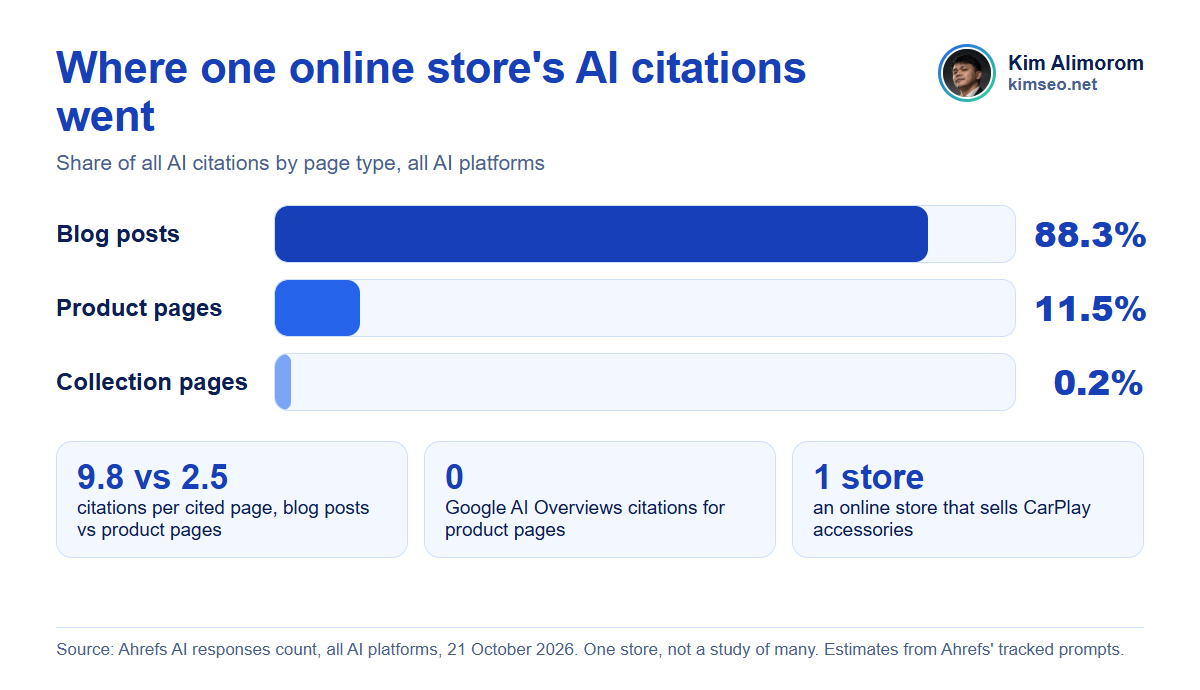
- Write guides first. Blog posts earned 88.3% of this store's AI citations.
- Don't expect product pages to be the source. They earned 11.5% and none of the Google AI Overviews citations.
- Let guides send buyers onward. Link each guide to the products it helps sell.
- Stay eligible. Google says a page needs to be indexed and snippet eligible, with no extra requirements.
- Measure, then repeat. Check citations by page, because the pattern may differ on your site.
What One Store's AI Citations Look Like
AI citations are the links that AI answers show as sources. Ahrefs tracks them across Google AI Overviews, AI Mode, ChatGPT, Perplexity, Gemini, Copilot and Grok. For this store I split the citations by page type: blog posts, product pages and collection pages.
| Page type | Share of all AI citations | Citations per cited page | Google AI Overviews citations |
|---|---|---|---|
| Blog posts | 88.3% | 9.8 | Nearly all of the store's |
| Product pages | 11.5% | 2.5 | None |
| Collection pages | 0.2% | Under 1 | Almost none |
The second column shows where the citations went. The third shows how often each cited page was cited: a cited blog post averaged almost four times as many citations as a cited product page. By platform, Gemini cited the store most often, followed by Google AI Overviews and Perplexity. AI Mode and Copilot were level, and ChatGPT cited it least.
Cite This Data
On an online store that sells CarPlay accessories, 88% of AI citations went to blog posts. Product pages earned 11.5% and none of the Google AI Overviews citations. Source: Ahrefs, all AI platforms, 21 October 2026. Kim Alimorom, kimseo.net: https://kimseo.net/blog/how-to-increase-ai-citations/
How I Pulled The Numbers, And What They Can't Tell You
I used Ahrefs' AI citation counts for the store's domain, then repeated the count for the blog, product and collection sections of the site on the same day. Three limits matter. These are Ahrefs estimates based on the prompts it tracks, not every question people ask. This is one store, not a study of many. And the counts change daily, which is why the chart carries a date. Treat the pattern as a strong clue to test on your own site, not a rule.
Write The Guides Buyers Search For
Start with the content that earned most of the citations here: buying guides, how to articles and comparisons that answer a real question. Pick the questions your customers ask before they buy, and answer each one directly in the first paragraph, then explain. Google's own guidance for its AI features says the same basics apply as for ordinary search, so helpful, original pages that a person would actually want are the foundation. Google's guidance on creating helpful, reliable, people first content is a good reference. Our guide to how to optimize for AI search covers the wider picture.
Connect Each Guide To The Products It Helps Sell
If guides collect the citations, they should send readers somewhere. Link each guide to the product or collection it relates to, using plain anchor text, and mention the product where it is genuinely the answer. A cited guide that leads to the right product turns an AI mention into a visit that can sell something. Don't force a product into a guide where it doesn't belong, because that reads as an advert and weakens the guide.
Give Product Pages Facts That Are Easy To Quote
Product pages earned a smaller share, but they were cited, so they are worth getting right. State what the product is, who it fits, its key specifications and what is included, in clear sentences and tables rather than only in images. Make sure any structured data matches what shoppers can see on the page. Our guide to optimizing product pages goes through this in order.
| Page type | Job in AI answers | What to put on it |
|---|---|---|
| Guide or comparison | The page most likely to be cited | A direct answer first, then steps, tables and honest limits |
| Product page | Cited less often, but still cited | Clear specifications, compatibility and what is included |
| Collection page | Rarely cited in this data | A short helpful introduction and links to the right guides |
Keep Every Page Open To Google's AI Features
Google's documentation on AI features and your website says there are no additional requirements to appear in AI Overviews or AI Mode. A page must be indexed and eligible to show in Search with a snippet. The same page says crawling must be allowed in robots.txt and by any CDN or hosting layer, that structured data should match the visible text, and that you don't need special schema or new machine readable files. In practice, check that your guides are indexed, that nothing blocks Googlebot, and that you haven't set snippet limits by accident.
Get Mentioned On Pages AI Already Cites
Mentions on other sites are off page work: earning a link or a mention from a relevant page that AI answers already use as a source. It makes sense, because those are the pages being cited. But I don't have data from this store showing that it raises citations, so treat it as a reasonable step, not a proven one. Choose relevant sites, keep it honest, and avoid buying links.
How To See Which Of Your Pages Get Cited
There are three ways to check. First, an AI citation report in a tool such as Ahrefs shows citations by page and by platform, which is where the figures above came from. Second, Google says traffic from its AI features is included in Search Console's Performance report under the Web search type, so you can watch clicks and impressions for the pages you expect to be cited. Third, ask the questions your customers ask in the AI tools you care about, on the same day each month, and note whether your pages appear. Keep a simple sheet so you can compare month to month. Our guide to what generative engine optimization is explains the thinking behind tracking this.
The Steps In The Order I'd Do Them
| Priority | Task | Why it matters |
|---|---|---|
| Highest | Publish guides that answer buyer questions | This is where most citations went in the data |
| High | Confirm those guides are indexed and snippet eligible | Google lists this as the requirement for its AI features |
| High | Link each guide to the right products | Turns a citation into a visit that can sell |
| Medium | Add clear facts and matching structured data to product pages | Gives product pages a chance to be quoted |
| Medium | Measure citations by page each month | Shows what works on your own site |
| Lower | Earn mentions on pages AI already cites | A reasonable step, not a proven one |
What This Data Can't Prove
- It's one store. Another store or industry may show a different split.
- Citations aren't clicks. A citation means a page was shown as a source, not that anyone visited it.
- Counts move. Ahrefs numbers change daily, so compare like with like and note the date.
- Nobody can promise a citation. Google says meeting the requirements doesn't guarantee a page will be crawled, indexed or served.
- Cause is not proven. The data shows where citations landed, not why.
Questions About Earning AI Citations
What Are AI Citations?
They are the links an AI answer shows as its sources, in tools such as Google AI Overviews, AI Mode, ChatGPT, Perplexity, Gemini and Copilot. A citation is not the same as a click.
How Long Does It Take To Increase AI Citations?
Nobody can say for certain. A page first has to be indexed, and citation counts then move from day to day. Check monthly and look at the trend, not a single day.
Do AI Citations Improve My Google Rankings?
I don't have data showing that they do. Google says its AI features use the same indexing and snippet requirements as Search, and counts the traffic in the Web performance report. Track citations and rankings as two separate measures.
Do I Need Special Schema Or An Llms.Txt File?
Google's page on AI features says you don't need special schema or new machine readable files to appear in AI Overviews or AI Mode, and it doesn't mention llms.txt. Structured data should match what visitors can see on the page.
Should I Optimize Product Pages For AI Citations?
Yes, but keep expectations realistic. In this store's data, product pages earned 11.5% of citations and none from Google AI Overviews, so guides carried most of the weight.
How Do I Check Which Of My Pages Are Cited?
Use an AI citation report such as Ahrefs, watch the Web performance report in Search Console, and repeat the same customer questions in AI tools each month.
Can You Help Increase My Store's AI Citations?
Yes. It is part of my AI SEO and GEO work. Send your store through the contact page and I will review it first at no cost.
How Much Does It Cost?
It depends on your site and what it needs. I give a clear quote after a free first audit, so you know what you are paying for.
Start With The Guide Buyers Already Read
You don't need to rebuild your site. Find the guide or article your customers already read most, make sure it answers its question in the first paragraph, confirm it is indexed, and link it to the right products. Then check next month whether it shows up as a source, and repeat the process with the next guide.
If you'd like help with your own site, see my AI SEO and GEO service or request a free SEO audit.

Need Help With AI SEO & GEO?
Get your brand cited in AI Overviews, ChatGPT, Gemini and Perplexity answers.
See the AI SEO & GEO service